



"The Moving Finger writes; and, having writ,
Moves on: nor all thy Piety nor Wit
Shall lure it back to cancel half a Line,
Nor all thy Tears wash out a Word of it."
— According to Omar Khayyam, Rubáiyát (via FitzGerald translation)

The Questions You Can't Ask
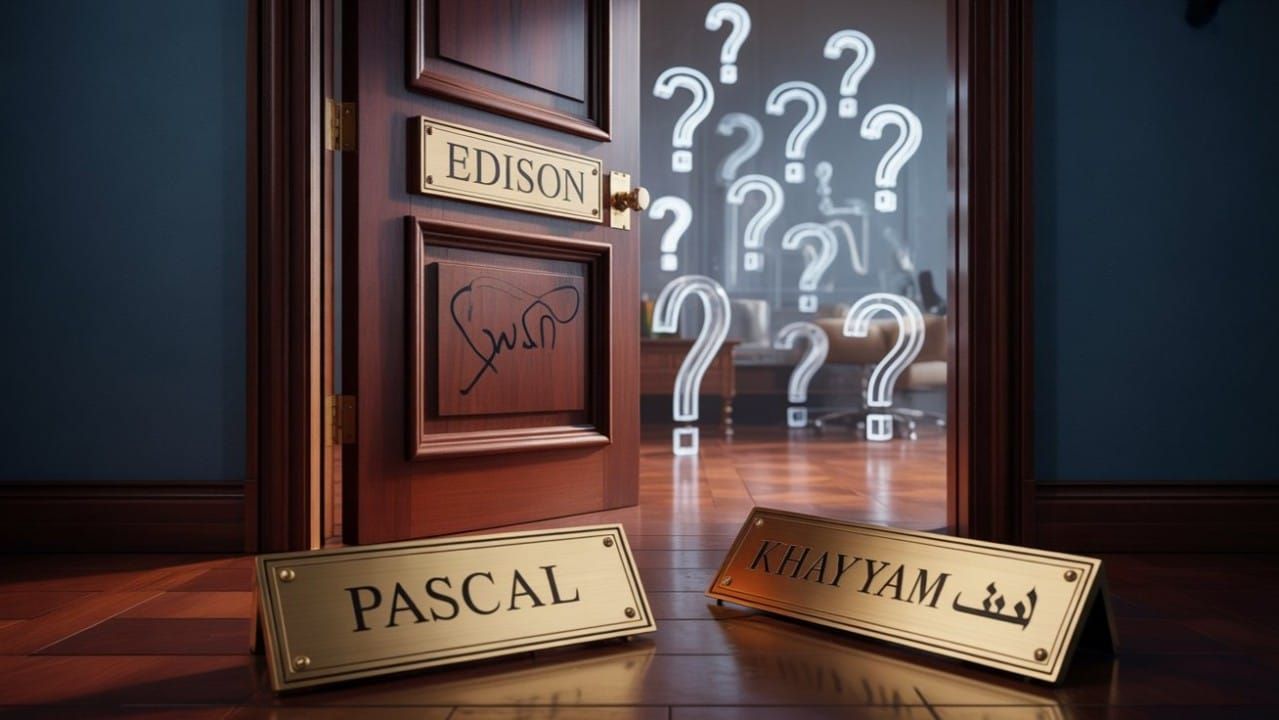
The name on the door doesn't just bias your answers, it determines which questions you can even formulate...
Last week's essay ended with a question that I couldn't shake for the whole week: is the correction mechanism itself still functioning? I mapped out the machinery keeping us confidently wrong; economic entrenchment, institutional inertia, all those non-epistemic functions that let wrong beliefs outlive the evidence against them. Meyers-Briggs Type Indicator (MBTI) hangs around because it feels good. Diagnostic and Statistical Manual of Mental Disorders (DSM) categories? Insurance companies need them. And the serotonin hypothesis persists mostly because the field has gotten very good at pretending its collapse wasn't that significant.
Those are all persistence mechanistic ways that wrong beliefs survive long after the evidence has killed them. But I missed something upstream. Before a belief can persist, it has to get installed in the first place. And the most efficient installation mechanism I've found? Not institutional inertia. Not economic entrenchment. Misattribution.
Most people treat misattribution as a fairness problem. Someone deserved credit, didn't get it. An unfortunate occurrence that happens to much, we should do better, let's add a footnote. Which, fine. But that's not what keeps me up at night.
The real problem is epistemic. When the wrong name's on the door, you ask the wrong questions and I don't mean because you're biased or lazy. The name on the door is an organizing principle. It tells you what kind of person made this contribution, under what conditions, using what methods. All the downstream answers flow from that initial attribution. Get it wrong, and everything that follows is wrong too. The field doesn't just fail the person who got erased, it fails itself…
The Edison Case Is Not About Edison
Ask anyone who invented the light bulb and they'll say Edison. The slightly better-informed crowd says "well, he didn't really invent it, he improved it." Both answers are setting you up to ask the wrong questions.
What actually happened is messier than the textbooks suggest. Humphry Davy demonstrated arc lighting in 1802. Warren de la Rue built a platinum-filament bulb in 1840. Joseph Swan developed a workable carbon-filament bulb in England in the 1870s. He demonstrated it publicly before Edison did. Hiram Maxim (yes, the machine gun guy) was working on incandescent bulbs at the same time.
Edison's contribution wasn't the bulb itself. It was building an integrated system. He combined a low-resistance carbon filament that could be mass produced with parallel circuit architecture, meters, generators, and distribution infrastructure. This made electrical lighting commercially viable at scale.
When you put "Edison" on the door, you start asking about the lone genius. What made him succeed where others failed? What was his unique insight? You end up with answers about heroism, inspiration, maybe persistence. We've been telling that story for 150 years. It's almost completely useless if you want to understand how transformative technologies actually develop.
Put the right names on the door: "Edison, Swan, de la Rue, Maxim, plus the entire industrial ecosystem of the 1870s" and suddenly you're asking different questions. What made the late 1870s the moment when all of these parallel efforts converged? Why did the patent system end up giving commercial credit to one person and technical credit to others? How did Edison's business model differ from pure inventors? He integrated generation, distribution, and end-use into a single commercial offering. Why did that integration matter? And the question that matters: why does this pattern keep showing up in major technological transitions? Multiple people independently inventing the same thing at roughly the same time.
These are the questions that might actually teach you something. The name on the door doesn't just bias your answers, it determines which questions you can even formulate.
Pascal's Triangle Is Not Pascal's Triangle
The triangle of binomial coefficients is called Pascal's Triangle in Western mathematics education. Each entry is the sum of the two above it. It generates the coefficients for polynomial expansions. Blaise Pascal published it in 1665, two years after his death, in his Traité du triangle arithmétique.
Omar Khayyam. Yes, the Rubáiyát guy, the one Westerners know mostly for wine-and-roses poetry was using this same triangle around 1070 CE to solve cubic and quartic equations. In Iran, they call it Khayyam's Triangle. Al-Karaji was working with it around 1000 CE. Jia Xian described it in 11th-century China. Yang Hui wrote about it in 1261. If you go back to Indian mathematics, the "Staircase of Mount Meru" traces similar ideas to Pingala around 200 BCE.
Pascal wasn't building on any of this, he was working independently. Which tells you something right there. But the name on the door in Western education is Pascal. So you end up asking: what did this 17th-century French mathematician discover about combinatorics and probability? How does this relate to the development of probability theory in Europe?
Now put the actual history on the door, a structure that got independently discovered across at least four distinct mathematical traditions over 1,800 years, and the questions get interesting fast: why does this particular structure emerge so reliably across radically different mathematical cultures? What does simultaneous independent discovery tell us about the relationship between mathematical structures and human cognition? What problems, present in every sophisticated mathematical tradition, make this triangle feel necessary? Like you almost can't avoid discovering it once you reach a certain level of mathematical sophistication? Is there something about the structure of binomial expansion that makes it particularly accessible regardless of cultural context?
These questions cut across philosophy of mathematics, cognitive science, sociology of knowledge. You can only ask them when the name on the door reflects the real story. "Pascal's Triangle" shuts them down because it implies a single inventor in a single tradition. The real history suggests something stranger: a universal structure that keeps getting discovered because it's somehow structurally inevitable.
In last week's essay, The Cost of Being Right, I talked about mathematics as the domain where error should be easiest to detect, where Kempe's false proof of the four-color theorem was accepted for eleven years despite being a purely logical argument scrutinized by experts. The Pascal case is the other side of that coin. It's not a logical error. It's an attributional error that forecloses an entire category of mathematical and philosophical questions. The wrong name doesn't produce a false theorem. It produces an impoverished research program.
Noether's Theorems Under the Wrong Name
Emmy Noether's two theorems, proving that every conservation law in physics corresponds to a continuous symmetry, and that local symmetries produce continuity equations rather than true conservation laws, were the work of an unpaid academic who lectured for years under David Hilbert's name because she wasn't allowed to officially hold a position.
Which creates a particular version of our problem. Hilbert wasn't trying to steal credit, he advocated for her, made her authorship clear in the relevant communications. But in the broader public understanding of who solved Einstein's energy problem, the answer is usually "Einstein figured it out eventually" or at best "Hilbert contributed." Noether is footnoted.
Put "Einstein-corrected-by-Hilbert" on the door and you're asking about Einstein's intellectual journey. What mathematical tools did he develop? How did his understanding evolve? It becomes a biographical story. Borderline hagiographic, honestly.
Put Noether on the door and suddenly: how did someone without official academic standing become the person who solved the foundational problem that both Einstein and Hilbert couldn't crack? What does it tell us about the relationship between institutional recognition and actual intellectual contribution when the person who solved the problem wasn't even allowed to officially hold the job she was doing? And here's where it gets uncomfortable: what problems right now are being solved by people without official standing, whose work will get absorbed into the credited contributions of people who do have standing?
That last question matters most. And physics almost never asks it about its own current practice—because asking it would mean admitting the Noether situation wasn't a historical anomaly. It's a structural feature. Still operating. Different social mechanisms now, maybe, but the same epistemic effect: the people who get the questions asked about them are the people whose names are already on the doors.
Last week, we established that the DSM's categorical system persists because it's load-bearing for insurance billing, legal proceedings, and pharmaceutical trial design. Noether's erasure persists for similar reasons, the narrative of physics as a progression of recognized geniuses is load-bearing for funding structures, hiring practices, and the institutional self-image of elite departments. You can't just correct the attribution without the field having to ask how its credentialing system shapes what it's able to discover. That question threatens too many non-epistemic functions.
The Mechanism: How it Works
So why does the wrong name generate the wrong questions? Once you see it, it's obvious.
Names are cognitive shortcuts for causal chains. When you attribute a discovery to a person, you’re making a claim about how it happened. This kind of person, with this kind of training, in this kind of environment. Attribution is a compressed causal story.
Get the attribution wrong and the causal story goes wrong. That wrong story propagates efficiently because it's compressed. Everyone who learns "Edison invented the light bulb" acquires a wrong theory of how technology develops. Everyone who learns "Pascal discovered his triangle" gets the wrong model of mathematical discovery. Tell people Hilbert solved the energy problem in general relativity, and they learn something false about how physics advances.
Your causal theory shapes what questions you can ask. If you believe Edison succeeded because of individual genius, you look for individual genius as the explanatory variable in future technological transitions. You miss the systematic factors — infrastructure readiness, patent environment, capital availability, parallel independent development — because your causal model doesn't have slots for them.
If you believe mathematical discovery is primarily a Western European tradition with occasional contributions from elsewhere, you fail to ask why every sophisticated mathematical tradition independently discovered the same structures and that might be one of the most interesting questions in the philosophy of mathematics.
If you believe theoretical physics advances through the heroic efforts of recognized geniuses like Einstein, you fail to examine the structural mechanisms by which unrecognized contributors — people outside the credentialing system, people doing the foundational mathematical work that enables the recognized genius to solve the problem — are systematically excluded from the attributional record.
The wrong name doesn't just give you wrong answers. It shapes which questions feel worth asking at all.
The Cost of Being Right showed how wrong beliefs persist when the non-epistemic functions they serve make correction too costly. This is that same mechanism operating one level deeper. Wrong attributions persist because they install wrong causal models. Wrong causal models generate wrong questions. Wrong questions mean the field never arrives at the evidence that would trigger the correction. The correction isn't just delayed, it's structurally foreclosed. You can't correct an error you can't formulate as a question.
When the Wrong Name Is an Entire Category
The individual misattribution cases are relatively tractable. You can correct the record on Edison, Pascal, and Noether. The corrections have been made, at least within relevant scholarly communities. The popular understanding lags, but the corrected version exists and is accessible.
The harder case is when the wrong name isn't an individual, it's an entire category.
Consider what gets called "folk medicine" versus "traditional medicine" versus "indigenous knowledge systems." These are labels for bodies of pharmacological and botanical knowledge developed over centuries or millennia by communities that didn't have Western academic infrastructure. The active compounds in aspirin were derived from willow bark. Cultures around the world used willow bark medicinally for thousands of years before anyone isolated acetylsalicylic acid. Artemisinin is our most effective malaria treatment, the one that won Tu Youyou the 2015 Nobel Prize and comes from Artemisia annua. Chinese medicine has used that plant for about 2,000 years.
When the name on the door is "Bayer" for aspirin and some Western pharma company for whatever the next artemisinin will be, you ask: how did Bayer develop this compound? What research processes led to the discovery? The actual causal chain, which begins with centuries of practical knowledge developed by communities with no institutional recognition, is invisible.
This isn't just an attribution injustice. It shapes where researchers look. Where they expect to find the next compound, the next treatment. If you believe useful pharmacological knowledge is produced by institutional research programs, you fund institutional research programs and mine existing literature. If you understand that there are large repositories of empirically developed knowledge in traditional medicine systems that haven't been integrated into the institutional record, you ask completely different questions about where to look, and you find things you wouldn't have found otherwise.
Tu Youyou found artemisinin because in 1969 someone told her to go survey ancient Chinese medical texts for malaria treatments. Part of a systematic program. She found what she needed in Ge Hong's Emergency Prescriptions Kept Up One's Sleeve from the 4th century CE. She read it. She found the reference. She ran the trials. She won the Nobel. The causal chain runs through 1,600 years of traditional Chinese medicine, not through any Western pharmaceutical research program.
If the wrong name is on that door, if the attributed source is "institutional pharmaceutical research" rather than "long-term traditional knowledge" — you never go looking in Ge Hong's 4th-century text. The question doesn't occur to you.
In The Cost of Being Right last week, examined how the cholesterol correction took thirty years from when the evidence started moving to when the policy fully caught up. The artemisinin case inverts that timeline: the evidence existed for 1,600 years before anyone in the credited research tradition thought to look for it. The correction wasn't delayed by institutional inertia. It was delayed by categorical misattribution. The wrong kind of knower was on the door. This made the knowledge invisible to research programs that could have used it.
This Is Happening Right Now
None of this is historical. The wrong-name problem is active right now, in every field where attribution is contested or unclear.
In artificial intelligence, there is a live question about what ideas were developed by researchers at which institutions, and how those ideas were absorbed into the products of companies with the resources to implement them at scale. The credited history of transformer architectures, attention mechanisms, and the specific design choices that made large language models work traces largely through a small number of well-resourced labs and their published papers. The actual intellectual lineage is considerably more distributed through workshop papers, preprint servers, informal communications, and the work of researchers at smaller institutions whose contributions were adjacent to but preceded the credited breakthroughs.
This matters not because someone deserves more credit, but because of what it does to funding. If the field believes transformative AI came from a small number of elite labs following identifiable research programs, it keeps funding elite labs following identifiable research programs. If the actual history shows key ideas came from distributed, less-resourced sources whose work got synthesized (not originated) by the credited labs, you'd organize funding, hiring, institutional structure completely differently. The wrong name on the door shapes which labs get funded to produce the next breakthrough.
We introduced the category of AI-accelerated entrenchment of wrong beliefs, paper mills flooding the scientific literature with fabricated research at industrial scale last week. Here's the connection: those paper mills are disproportionately hosted at institutions whose names carry less attributional weight. The correction mechanism, peer review, already struggles to filter fabricated work. When the fabrication is associated with names and institutions that reviewers are predisposed to scrutinize for the wrong reasons (or not scrutinize carefully enough), the wrong-name problem compounds the AI-generated noise problem. Attribution bias and automated fabrication aren't independent threats to the correction mechanism, they're synergistic.
In medicine, the misattribution problem manifests in clinical research that systematically underrepresents the populations most likely to be affected by the diseases being studied. When the name on the door of medical knowledge is effectively "white male subjects from developed countries," you ask questions about that population's physiology and pharmacology. The answers you get are wrong for everyone else, and you don't even know they're wrong because the question of generalizability was never asked. The AI bias work documented in the NIST 2019 tests shows facial recognition error rates up to 100 times higher for Black and Asian faces than for white faces. This is a direct consequence of training sets that were primarily white faces. The wrong population was “on the door” of the training data.
What This Means for This
The practical implication isn’t mainly about correcting historical attribution records. Though we should do that too. It’s about developing a habit. When you encounter a knowledge claim, ask whose name is on this door. Then ask what questions that name prevents you from asking.
Ask what questions become available when you put the right names on the door. Ask. what the simplified attribution forecloses.
I'm not demanding epistemological perfectionism here. You don't need every attribution to be fully attribution to be fully accurate before you can use the knowledge. What you need is a habit of noticing what the name on the door does to your inquiry. What it makes invisible. What questions it makes unaskable. What explanatory variables it trains you to ignore.
Last week we argued that you should ask what non-epistemic functions your beliefs serve. W19 adds the upstream question: what non-epistemic functions does the attribution serve? Because the attribution installs the causal model, and the causal model generates the questions, and the questions determine which evidence you encounter. If the attribution's wrong, the entire downstream chain is corrupted before the belief even forms.
The Edison myth isn't just wrong—it's actively making you worse at understanding technological change. The Pascal myth isn't just incomplete—it's actively making you worse at understanding mathematical discovery. The Noether erasure isn't just unjust, it's making physics worse at asking questions about its own knowledge production.
When you put the wrong name on the door, you'll never be able to ask the right questions.
I'm not being poetic here, or am I? This is what happens every time attribution fails, in every field, at every level. The injustice is real. But the intelligence cost? That's what should keep you up at night.
Don't miss the weekly roundup of articles and videos from the week in the form of these Pearls of Wisdom. Click to listen in and learn about tomorrow, today.
Sign up now to read the post and get access to the full library of posts for subscribers only.
🌶️ iamkhayyam
About the Author
Khayyam Wakil is a researcher at The ARC Institute of Knowware and founder of CacheCow Systems Inc., an Agriculture Intelligence suite (which is either a livestock intelligence company or the only EMP-hardened food security infrastructure being built without anyone asking for it, depending on when you're reading this). His work spans epistemology, institutional behavior, and the mechanics of knowledge correction, the gap between what civilizations know and what they build.
He is the author of the forthcoming Knowware: Systems of Intelligence — The Third Pillar of Coordination and The Constitutional Sieve Research Programme. Token Wisdom is where he writes while the work is still warm. He remains professionally uninterested in whether this essay makes you comfortable.
References & Sources
- Wakil, K. (2026). "The Cost of Being Right." Token Wisdom, ACL.158, W18. — The immediately preceding essay in the series. Established the taxonomy of how wrong beliefs persist (definitional errors, pedagogical oversimplifications, economically entrenched false beliefs, socially functional pseudoscience, and AI-accelerated entrenchment). Its central finding — that wrong beliefs persist in proportion to how many non-epistemic functions they serve — is the framework W19 extends upstream to attribution. W18's closing question ("Is the correction mechanism itself still functioning?") is the direct departure point for this essay.
- Wakil, K. (2024). "The Cost of Being Right." Token Wisdom, ACL.90, W53. — The original version of the essay updated in W18. Introduced the taxonomy and identified MBTI, the DSM, and dietary cholesterol as active case studies.
- Davy, H. (1802). Demonstrated arc lighting using a voltaic pile at the Royal Institution, London. The first public demonstration of sustained electric illumination. See: Bowers, B. (1998). Lengthening the Day: A History of Lighting Technology. Oxford University Press.
- de la Rue, W. (c. 1840). Produced one of the earliest incandescent lamps using a platinum filament in a vacuum tube. See: Friedel, R. & Israel, P. (1986). Edison's Electric Light: The Art of Invention. Johns Hopkins University Press, pp. 5–8.
- Swan, J. W. (1878–1879). Demonstrated a workable carbon-filament incandescent lamp publicly in Newcastle, England, in 1878–1879 — prior to Edison's demonstrations. Swan held a British patent and formed the Swan Electric Light Company. See: Friedel, R. & Israel, P. (1986). Edison's Electric Light, ch. 1; Bowers (1998), ch. 8.
- Maxim, H. S. (c. 1878–1880). Developed incandescent lamps independently while employed at the United States Electric Lighting Company. Filed multiple patents on carbon-filament bulbs. Better known for inventing the Maxim machine gun in 1884. See: McCallum, I. (1999). Blood Brothers: Hiram and Hudson Maxim — Pioneers of Modern Weapons. Chatham Publishing.
- Edison's contribution as systems integration, not bulb invention. Edison's specific innovation was combining a high-resistance, low-power-consumption carbon filament with parallel circuit distribution architecture, metering, generation, and commercial infrastructure. See: Hughes, T. P. (1983). Networks of Power: Electrification in Western Society, 1880–1930. Johns Hopkins University Press — the foundational text on Edison's contribution as system builder rather than lone inventor. Also: Friedel, R. & Israel, P. (1986). Edison's Electric Light: The Art of Invention. Johns Hopkins University Press.
- Simultaneous independent invention as a pattern in technological change. Ogburn, W. F. & Thomas, D. S. (1922). "Are Inventions Inevitable? A Note on Social Evolution." Political Science Quarterly, 37(1), 83–98. https://doi.org/10.2307/2142320 — The landmark paper cataloging 148 cases of simultaneous independent invention. Merton, R. K. (1961). "Singletons and Multiples in Scientific Discovery." Proceedings of the American Philosophical Society, 105(5), 470–486 — extended the analysis.
- Pascal, B. (1665). Traité du triangle arithmétique, published posthumously. Pascal was working independently from the non-European traditions. See: Edwards, A. W. F. (2002). Pascal's Arithmetical Triangle: The Story of a Mathematical Idea. Johns Hopkins University Press — the standard reference on the triangle's history across traditions.
- Khayyam, O. (c. 1070 CE). Used the triangle of binomial coefficients to solve cubic and quartic equations. In Iran the structure is called "Khayyam's Triangle" (مثلث خیام). See: Berggren, J. L. (2007). "Mathematics in Medieval Islam," in Katz, V. J. (ed.), The Mathematics of Egypt, Mesopotamia, China, India, and Islam: A Sourcebook. Princeton University Press, pp. 515–675.
- Al-Karaji (c. 1000 CE). Explored the binomial theorem and the triangle of coefficients in his work al-Fakhri. See: Rashed, R. (1994). The Development of Arabic Mathematics: Between Arithmetic and Algebra. Springer, pp. 62–84.
- Jia Xian (11th century CE); Yang Hui (1261 CE). Jia Xian described the triangle in 11th-century China; Yang Hui's Xiangjie jiuzhang suanfa (1261) explicitly depicted it. In China the structure is called "Yang Hui's Triangle" (杨辉三角). See: Martzloff, J.-C. (1997). A History of Chinese Mathematics. Springer-Verlag, ch. 14.
- Pingala (c. 200 BCE). The "Staircase of Mount Meru" (Meruprastāra) in Indian mathematics, which enumerates combinatorial patterns structurally related to the binomial triangle, is traced to Pingala's Chandaḥśāstra. See: Plofker, K. (2009). Mathematics in India. Princeton University Press, pp. 55–60.
- Kempe's false proof of the four-color theorem (1879), cross-reference from W18. Alfred Kempe published a purported proof in 1879 in the American Journal of Mathematics; the flaw was found by Percy Heawood in 1890. See: Wilson, R. (2002). Four Colors Suffice: How the Map Problem Was Solved. Princeton University Press. W19 uses this as a counterpoint: Kempe was a logical error undetected for eleven years; Pascal's misattribution is an attributional error that forecloses an entire category of questions indefinitely.
- Noether, E. (1918). "Invariante Variationsprobleme." Nachrichten von der Gesellschaft der Wissenschaften zu Göttingen, Mathematisch-Physikalische Klasse, 1918, 235–257. English translation: Tavel, M. A. (1971). Transport Theory and Statistical Physics, 1(3), 186–207. https://doi.org/10.1080/00411457108231446
- Noether lecturing under Hilbert's name. Noether was denied habilitation at the University of Göttingen despite Hilbert's advocacy. She lectured for years under Hilbert's name (courses were officially listed as his). See: Dick, A. (1981). Emmy Noether: 1882–1935. Birkhäuser Boston; Rowe, D. E. (1999). "The Göttingen Response to General Relativity and Emmy Noether's Theorems," in The Symbolic Universe: Geometry and Physics 1890–1930, Gray, J. (ed.), Oxford University Press, pp. 189–233.
- Hilbert's relationship to Noether's work and the Einstein energy problem. Hilbert invited Noether to Göttingen specifically to resolve the energy conservation problem in Einstein's general relativity that he and Einstein had been unable to solve. Hilbert was explicit about her authorship. See: Rowe, D. E. (1999); Byers, N. (1996). "E. Noether's Discovery of the Deep Connection Between Symmetries and Conservation Laws." Israel Mathematical Conference Proceedings, 12. arXiv:physics/9807044.
- Wakil, K. (2025). "The Speed Trap." Token Wisdom, W50 (December 2025). — Prior examination of how the DSM's categorical framework pathologizes cognitive variation, specifically how ADHD diagnostic criteria mistake processing speed differences for disorder. The structural critique of categorical diagnosis developed there anticipated the APA's 2026 acknowledgment that the DSM fails to accommodate dimensional symptom presentation. W19 extends this line through the Noether case: the DSM's categorical system and physics' lone-genius narrative persist for the same structural reason — both are load-bearing for non-epistemic functions.
- DSM categorical system as load-bearing infrastructure, cross-reference from W18. W19 draws a structural parallel between the DSM's persistence (serving insurance billing, legal proceedings, pharmaceutical trial design) and the persistence of the lone-genius narrative in physics (serving funding structures, hiring practices, institutional self-image). Both are cases where the wrong framework persists because it is load-bearing for non-epistemic functions.
- Attribution as compressed causal story. The argument that names function as cognitive shortcuts for causal chains draws on: Kuhn, T. S. (1962). The Structure of Scientific Revolutions. University of Chicago Press — on how paradigms shape which questions feel worth asking. Merton, R. K. (1968). "The Matthew Effect in Science." Science, 159(3810), 56–63. https://doi.org/10.1126/science.159.3810.56 — on how credit accrues disproportionately to already-recognized scientists (relevant to the Noether case and to the AI attribution question). Stigler, S. M. (1980). "Stigler's Law of Eponymy." Transactions of the New York Academy of Sciences, 39(1), 147–157. https://doi.org/10.1111/j.2164-0947.1980.tb02775.x — Stigler's law states that no scientific discovery is named after its original discoverer. Stigler attributed this law to Merton, in a deliberate self-referential demonstration.
- Aspirin and willow bark. Salicin was first isolated from willow bark (Salix species) by Johann Buchner in 1828, building on millennia of medicinal use of willow across multiple cultures. Acetylsalicylic acid was synthesized by Felix Hoffmann at Bayer in 1897. See: Jeffreys, D. (2004). Aspirin: The Remarkable Story of a Wonder Drug. Bloomsbury.
- Tu Youyou, artemisinin, and Ge Hong's text. Tu Youyou received the 2015 Nobel Prize in Physiology or Medicine "for her discoveries concerning a novel therapy against Malaria." She was instructed in 1969, as part of Project 523, to survey ancient Chinese medical texts for malaria treatments. The relevant text: Ge Hong 葛洪, Zhouhou Beiji Fang (肘後備急方), "A Handbook of Prescriptions for Emergencies," East Jin Dynasty, c. 340 CE. Tu credited this text in her Nobel lecture: Tu, Y. (2015). "Discovery of Artemisinin — A Gift from Traditional Chinese Medicine to the World." Nobel Lecture, December 7, 2015. Available at: https://www.nobelprize.org/prizes/medicine/2015/tu/lecture/
- Artemisia annua in Chinese traditional medicine. The plant qinghao (青蒿, Artemisia annua) has been used in Chinese medicine for approximately 2,000 years for febrile conditions. See: Hsu, E. (2006). "Reflections on the 'discovery' of the antimalarial qinghao." British Journal of Clinical Pharmacology, 61(6), 666–670. https://doi.org/10.1111/j.1365-2125.2006.02673.x
- Dietary cholesterol thirty-year correction cycle, cross-reference from W18. W19 inverts this timeline with the artemisinin case: the cholesterol correction took thirty years from evidence to policy change; the artemisinin case involved evidence (traditional knowledge) that existed for 1,600 years before the credited research tradition thought to look for it. The delay was not institutional inertia but categorical misattribution — the wrong kind of knower was on the door.
- Distributed intellectual lineage of transformer architectures and attention mechanisms. The credited history traces primarily through Vaswani, A. et al. (2017). "Attention Is All You Need." Advances in Neural Information Processing Systems 30 (NIPS 2017). But the intellectual lineage of attention mechanisms and sequence-to-sequence learning is considerably more distributed. See: Bahdanau, D., Cho, K., & Bengio, Y. (2015). "Neural Machine Translation by Jointly Learning to Align and Translate." Proceedings of the 3rd International Conference on Learning Representations (ICLR 2015) — developed the attention mechanism that Vaswani et al. extended. See also: Hochreiter, S. & Schmidhuber, J. (1997). "Long Short-Term Memory." Neural Computation, 9(8), 1735–1780 — foundational work on sequence processing from a smaller institution.
- AI-generated paper mills and the replication crisis, cross-reference from W18. Bernard, C. (2026). "AI-Generated Scientific Papers: Crisis? What Crisis?" eNeuro, January 7, 2026. https://doi.org/10.1523/ENEURO.0470-25.2025 — First referenced in ACL.158, W18. W19 extends the argument: attribution bias (which names and institutions reviewers scrutinize or defer to) compounds the paper mill problem because the correction mechanism — peer review — does not operate independently of the attributional hierarchy.
- Grother, P., Ngan, M., & Hanaoka, K. (2019). Face Recognition Vendor Test (FRVT) Part 3: Demographic Effects. NIST Interagency Report 8280, December 2019. National Institute of Standards and Technology. https://doi.org/10.6028/NIST.IR.8280 — Tested 189 facial recognition algorithms from 99 developers. Found false positive rates 10 to 100 times higher for African American and Asian faces compared to Caucasian faces in one-to-one matching tasks. Native Americans had the highest false positive rates in U.S. mugshot datasets. Algorithms developed in Asian countries showed reduced demographic differentials for Asian faces, suggesting training data composition is the primary driver.
#epistemology #attribution #misattribution #historyofscience #knowledgeproduction #institutionalbias #Edison #Noether #Pascal #OmarKhayyam #correctionmechanism #wrongquestions #AIbias #facialrecognition #traditionalmedicine #artemisinin // #constitutional #forcing #longread | 🧠⚡ | #tokenwisdom #thelessyouknow 🌈✨


Member discussion