

"It is not knowledge, but the act of learning — not possession, but the act of getting there — which grants the greatest enjoyment."
— According to Carl Friedrich Gauss

What the Hardware Knew First
A pattern that has been hiding in mathematics for a thousand years…
December 31st, 2022. It's twenty minutes to midnight in Saskatoon. Minutes before a deadline for an NEC accelerator — the gatekeepers on all things biometrics, there isn't an airport on this planet that isn't running something of theirs — I submitted a system-on-chip concept that had five silicon chips powering it, architected in two days. The idea had come to me earlier that month. Most of the work was already done in my head through simulations and model-based reinforcement learning. The constraints were insane. The core logic was ternary — three states, not two. {−1, 0, +1}. Inhibitory, silent, excitatory. I didn't choose ternary because it was elegant. I chose it because biology forced my hand, and I was out of time.
I didn't know yet that those three states were going to lead me into the middle of a thousand-year-old mathematical argument. I didn't know that the same ternary logic was quietly operating in the distribution of prime numbers, in the hexagonal geometry of the Eisenstein integers, in a fractal that had been sitting in plain sight since the eleventh century under the wrong man's name.
I didn't know any of that. I just knew I had twenty minutes, and a battery that needed to last two years.
What the Constraint Forced
From close to 400 submissions, I was one of 37 chosen. I shared the news with Dean — my co-founder, the third-smartest person I know, a man who once successfully transmitted data over phone lines at the speed of fiber at 1/1000th of the cost. He immediately asked who had copies of the deck. There were a handful of people and maybe five or six at NEC. He didn't suggest I get them back. He demanded it. Dean has good instincts about these things.
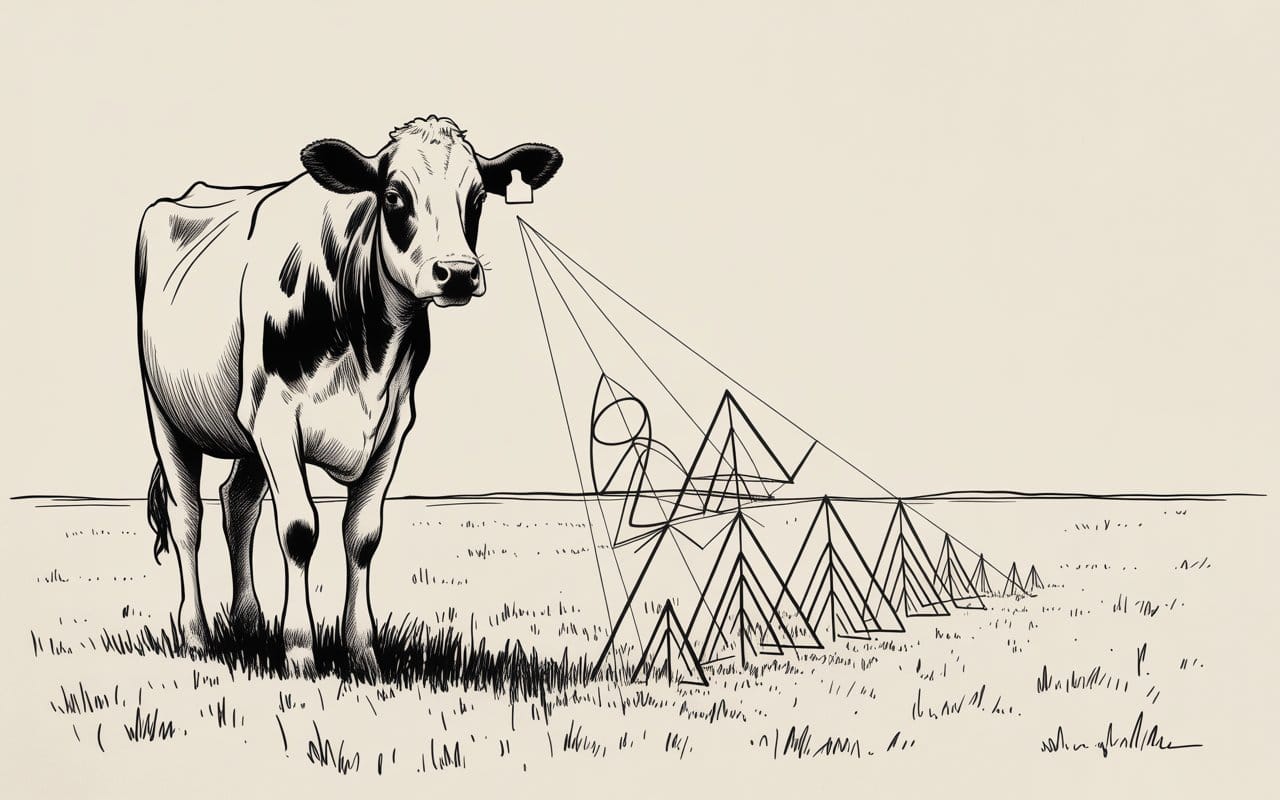
That submission eventually became CacheCow — a cattle health monitoring platform. Nine neural organs on a wearable ear tag. The tag needed to run on biological compute principles: efficient, low-power, fault-tolerant. The ternary logic wasn't decoration. It was the only thing that fit the constraints. You can't argue with a battery budget.
But here's the thing about working inside impossible constraints: they tend to reveal structure that the unconstrained path walks right past. When you can't go around the wall, you start reading what the wall is made of.
The mod-3 patterns in the data kept showing up cleaner than they should have. Too clean. The kind of clean that means you're not looking at noise. You're looking at something the structure is forcing.
I'm not a number theorist. I'm an engineer who got curious at the wrong time of year, in the wrong city, with too much whiteboard space and not enough human contact.
The cattle tag was doing number theory before anyone knew to call it that. The hardware was constitutional before the mathematics arrived to say so.
Istanbul, Christmas, $580
I had sublet my place in Vancouver in October 2022 — heading to Lisbon, where the search for work happened. I thought about thinking around the thinking behind this problem. On the way, I stopped in Saskatoon to see my mother. She had five degrees, one of them mathematics. We could talk across the whole spectrum. A spectacular woman.
Lisbon became home for November and December. I found myself in Istanbul for Christmas and that's where I found out my mother was going to be alone that year for the first time in, well, I think forever. This could not stand. Once I knew, it took me two days to find the optimal route and book the flights. 57 hours to get home and $580 instead of $3,640.
Pattern recognition. It's like a superpower.
I woke up from the jet lag on December 30th. I had 37 hours.
2023
I submitted the proposal and stayed to ring in the New Year with my mother. We sat and watched what had become a tradition in our household — the ball drop.
I didn't work on the ear tag or the mathematics in 2023. I took care of her.
What I didn't know yet was how finite the time was. She had congestive heart failure, a fairly new pacemaker, and kidneys that had fought off the need for insulin for years — all converging at once. It was May when we got the news it had progressed to its last phase. The diagnosis gives a younger, relatively healthy person nine to twelve months. For my mother, we would compress that by a third. Time, in a second, became finite.
We made the most of it. I cooked meals and presented them on different plate settings with different silverware. We would travel to different lands through food — tasting whatever corner of the world we felt like inhabiting that evening. I became an obsessive documenter, photographing every meal, building a record of all the places we went together without leaving the house.
Canadian Thanksgiving, October 11th. Her higher processing centers went dark one by one. Faces became strangers. Mine. My brother's. Her own reflection. At the dinner table, she looked at me and without saying a word, she looked into my eyes and then through me, past me. She saw it before it came. She told me it was time. I didn't let go of her gaze. I held on to it as long as I could. I thought it would be the last thing she would remember and the last thing we'd be able to connect on.
But she always knew me by the way I walked into her room.
The gentle shuffle of my feet. The rhythm of my approach. Not a memory — something deeper than memory. You could visibly see the recognition arrive. Hardware encoded so far down, in systems so primitive and so persistent, that they survived long after everything built on top of them was gone. She couldn't tell you my name. She never once failed to recognize my walk.
I didn't have language for it then. I was just her son, doing what needed doing.
She passed away on October 17th, 2023.
The Floor Drops
On New Year's Day, 2024, I left Saskatoon. For over a year I had barely left that house — maybe an hour at a time. The only real human contact was one person, and that person would soon become the farthest. I knew I had to re-enter the world. My drive west eventually became LA, in February. The only safety net I had left — money I'd brought to build out the ear tag and put the math to the test — was stolen by someone I trusted completely. There's no elegant way to say it. The floor dropped out, just like watching the New Year's ball drop.
It wasn't until June that I got back to work. A dear friend gave me an environment where intellectual rigor was possible again — someone smart enough to call out the things I was trying to assemble, somewhere I could actually think.
By January 2025, the feasibility of pulling this off had become statistically promising. The timing was clarifying too: my E2 Investor Visa was expiring in February. One thing at a time, one constraint at a time. I texted Dean that I was heading up, and mentioned almost as an aside that the project had two applications now — the ear tag, and something else entirely. Counting cows.
"Call me."
I called. Before he could say anything, I asked him: "So — when did you build this?" He laughed. Then I laughed. "Seven years ago," he said. He had built essentially this same system. Now we'd do it again with sensors 10,000,000 times more sensitive and a small low-energy computer strapped to a cow's ear. The neuromorphic system had found its animal. The original application was for humans, but we realized very quickly — cows don't sue.
By March 2025, the platform's focus was the cattle tag. The ternary logic that had been waiting since December 2022 finally knew what body it was supposed to be on.
The constraint came first. The cow came last.
That summer I spent in serious deliberation — game theory, survival rates, what this path actually meant. I understood the weight of what I was choosing. I chose it anyway.
October 2025, I moved to Calgary to start starting. The whiteboard went up. November 2025 — the math began to move, geometrically.
The Wrong Name on the Triangle
You know Pascal's Triangle. Every entry is the sum of the two above it. It's in every combinatorics textbook. It encodes probability, combinations, the binomial theorem. Blaise Pascal wrote his treatise on it in 1654.
Omar Khayyam documented it around 1070. Pascal arrived 584 years late.
I should mention — I'm named after him. Khayyam. My parents gave me his name before I knew anything about mathematics, before I knew about the triangle, before I knew about the fractal hiding inside it. The name came first. The understanding came last. Which, now that I think about it, is exactly how Constitutional Forcing works.
In the West, we remember Khayyam as a poet — the Rubaiyat, wine and roses and the moving finger. What we've mostly forgotten is that he was one of the most precise geometers who ever lived. Between 1074 and 1079, using naked-eye instruments, he calculated the length of the solar year as 365.24219858156 days. Modern atomic-clock measurements give 365.242190 days. The discrepancy is 0.74 seconds per year. A man with sticks and shadows, working in 11th-century Persia, outperformed five centuries of subsequent institutional astronomy.
He wasn't lucky. He was asking a different question than everyone else. Not how many outcomes are possible? — Pascal's question, which built probability theory. Khayyam's question was: what structure is hiding here?
Those are not the same question. And they cannot see the same things.
Take the triangle. Replace every entry with its remainder after dividing by 3. Entries divisible by 3 go blank. Do this for hundreds of rows. What emerges is not a triangle. It's a fractal — infinite, self-similar, exact. Three smaller copies of the whole at the base level. Each containing three smaller copies. The self-similarity continues without bound.
This fractal has been sitting inside what we call Pascal's Triangle for over a thousand years. It was described for general audiences by Martin Gardner in 1977. Three centuries of intense mathematical study, and nobody asked Khayyam's question about it. Because they had Pascal's name on the door, and Pascal's question doesn't open that room.
The name on the triangle is wrong. That's not just a historical complaint. Wrong names produce wrong questions. And wrong questions cannot see the structure that the right question finds immediately.
What I Started Seeing Everywhere
Once I understood the mod-3 fractal in Khayyam's Triangle, I couldn't stop seeing the same pattern. Not as analogy. As recurrence. The same structure, appearing independently, across domains that had no reason to be talking to each other.
A constitutional constraint is a condition forced by what a system fundamentally is. Not a parameter you choose. Not an approximation. A constraint you cannot change without changing the system itself. The test is simple: could you pick a different value and still have the same object? If yes, it's not constitutional. If no — if changing it requires changing the nature of the thing — then it is.
What I found is a formula. When a system has k independent constitutional constraints on a binary configuration space, the forced governing constant is always the same:
𝛳_k = (2^k - k) / 2^k
The Constitutional Forcing Formula
It's a clean counting argument. A k-level system has 2^k total configurations. Each constitutional constraint eliminates exactly one. Valid configurations: 2^k − k. Governing constant: (2^k − k)/2^k. The proof is four lines of induction.
Now look at where this formula shows up — uninvited, unannounced, across nearly a thousand years:
Year | Domain | k | Result |
|---|---|---|---|
| 1070 | Khayyam's Triangle mod 3 — the Sierpiński fractal at scale 3^K is the combinatorial ancestor of the cascade moduli result. The same forced constant, arrived at through a different basis | 3 | ⅝ |
| 1941 | Kolmogorov's turbulence exponent — the vorticity dissipation rate in incompressible fluid dynamics, two constitutional constraints from the Navier-Stokes equations | 2 | ¾ |
| 1948 | Shannon's theorems — both the Asymptotic Equipartition Property and the Channel Coding Theorem are instances of forced dimensional reduction governed by a uniquely determined constant | 1 | ½ |
| 1965 | Bombieri–Vinogradov theorem — the classical ceiling on how far equidistribution of primes can be tracked across arithmetic progressions | 1 | ½ |
| 2025 | Cascade moduli — primes modulo powers of 3, where the Eisenstein integers force a three-level filtration and Kloosterman sum cancellation. Independently confirmed by Alessandro Pascadi at Cambridge (arXiv:2505.00653v2) for a completely different moduli family by completely different methods | 3 | ⅝ |
| 2026 | The DFT — the conjugate symmetry of the Discrete Fourier Transform, named here as a constitutional constant for the first time. The mod-2 void fraction of Khayyam's Triangle is the same ½, arrived at through modular arithmetic rather than Fourier analysis. Two basis changes. One structure. | 1 | ½ |
| Open | k = 5 prediction — if established analytically over a moduli family broad enough to serve as input to the Goldston–Pintz–Yıldırım theorem (2009), twin prime infinitude follows directly. The formula predicts the answer. The proof is the remaining work. | 5 | 27/32 |
These are not analogies. Analogies observe that two things look similar and draw heuristic inspiration. This is a common mechanism that independent systems instantiate. Two fires sharing the same oxygen. Shannon never heard of cascade moduli. Kolmogorov was not thinking about prime distribution. Nobody was looking for the others when they found their instance. The independence is the point. When six different fields, developed across centuries by people who never compared notes, force themselves to the same formal structure — that is evidence the structure is real.
Constitutional Forcing was not invented in 2026. It was operating in Khayyam's Triangle in 1070, in Shannon's Bell Labs notebook in 1948, in Kolmogorov's Moscow in 1941, in the primes since before any of them were born. The only thing that happened in 2026 was that someone finally looked at all of it at once and had a name ready.
What the Cattle Tag Knew
Edward Jenner used cowpox to end smallpox in 1796. The cow provided the biological template that taught the human immune system what a threat looks like before the threat arrives. Immunity by constitutional analogy — the body forced to recognize a pattern it hadn't yet encountered.
Two hundred and thirty years later: a different cow. A different template.
The CacheCow ear tag encodes {−1, 0, +1} — inhibitory, silent, excitatory — because those are the three states that biological neural systems use. Ternary. Not binary. The same ternary logic that governs the distribution of prime numbers. The same three-fold structure that the Eisenstein integers force on any sieve operating modulo powers of 3. The hardware was obeying Constitutional Forcing before Constitutional Forcing had a name.
I didn't discover this relationship. I recognized it. That's a different thing, and the difference matters. Recognition means the structure was already there. You just finally looked at it straight.
What My Mother Showed Me
I think the moment I actually understood Constitutional Forcing — not intellectually, but in my body — was 2023. In my mother's bedroom in Saskatoon, being with her.
She lost the software. The faces, the names, the recent memories, the ability to follow a conversation. The higher processing centers, going dark one by one. But the hardware persisted. The deep substrate — patterns encoded so far down, in systems so primitive and ancient, that they survived everything built on top of them. She recognized my walk. Every time. Until the very end.
That is Constitutional Forcing. Not as metaphor. As demonstration. The things that are constitutional — forced by the irreducible structure of what something is — are the things that persist when everything contingent is stripped away. You cannot change them without changing the organism. They are below the level of choice.
She had five degrees. One of them mathematics. And she showed me the mechanism before I had a name for it. I was just her son. I didn't have the language yet.
I have it now.
$ echo "It was not invented in 2026. It was recognized."
Why It Keeps Getting Missed
The honest answer is that we've been asking Pascal's question instead of Khayyam's. We've been asking how many? instead of what structure? We've been trying to calculate our way past the walls instead of reading what the walls are made of.
Every field that has hit a persistent barrier — sieve theory stuck at θ = ½ for two centuries, turbulence without an a priori reason for Kolmogorov's ¾, signal processing exploiting DFT symmetry without naming why it exists — has been treating the constraint as an obstacle. Constitutional Forcing says the constraint is the answer. The barrier is not in the way. The barrier is the information.
This isn't mysticism. It's geometry. It has always been geometry. The mathematicians who made progress past the walls — Khayyam, Kolmogorov, Shannon, Eisenstein — were all, in their different ways, asking the shape question instead of the counting question. Finding the structure hiding underneath the numbers rather than manipulating the numbers themselves.
We have a lot of knowledge. We are less sure we have been asking the right questions with it. That is not good enough. It wasn't good enough for Khayyam. It wasn't good enough for Shannon. A cattle ear tag running on ternary logic it didn't choose found the same structure they found — and forced the question back into the open.
The cow came last. But she knew first. And now, every time I look at the moon, I feel her. That's how I know I'm in line. Like my namesake, I'm using sticks and shadows — and terrifyingly accurate in my calculations.
🐄
Don't miss the weekly roundup of articles and videos from the week in the form of these Pearls of Wisdom. Click to listen in and learn about tomorrow, today.


Sign up now to read the post and get access to the full library of posts for subscribers only.
 🌶️ iamkhayyam
The Constitutional Sieve Programme — nine papers, nine essays, one mechanism — is available at the ARC Institute of Knowware. The principal open step is the extension of θ_W = 5/8 from cascade moduli to a family broad enough for GPY input. The formula predicts θ₅ = 27/32. Whether that prediction holds is a question for the mathematics, not for this essay.
About the Author
Khayyam Wakil studies the gap between what civilizations know and what they build.
He is the founder of CacheCow Agriculture Inc. — which is either a livestock intelligence company or the only EMP-hardened food security infrastructure being built without anyone asking for it, depending on when you're reading this.
The answer to the oldest infrastructure problem in the modern world is probably already in a field somewhere. He finds that funny. And clarifying.
He does not maintain a social media presence — with the exception of LinkedIn — which he acknowledges is a privilege, and a fact he finds genuinely uncomfortable.
Token Wisdom is where he writes while the work is still warm.
Subscribe at https://tokenwisdom.ghost.io
#constitutional #forcing #longread | 🧠⚡ | #tokenwisdom #thelessyouknow 🌈✨

Member discussion