
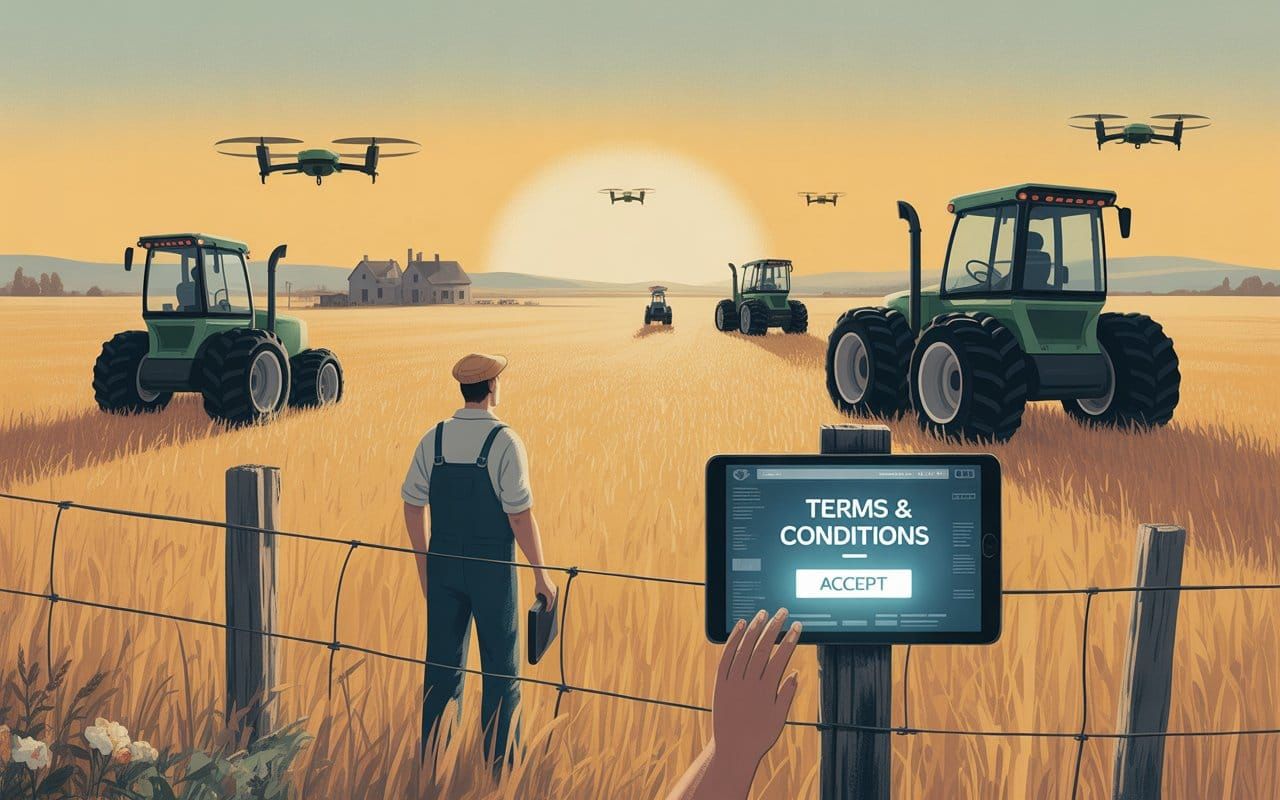



"For the first time ever it is possible that the elimination of a class is the precondition for the elimination of all classes. The peasantry is being eliminated. Their experience is therefore being eliminated. And nobody is recording what is being lost."
— Passage from Berger's preface to Pig Earth (1979)

And the structure of this argument is the proof.
On the dissolution of inheritance, the simulation theater of consent, and why this piece cannot be compressed without losing what makes it true...
In 1915, there were roughly 26 million working horses in the United States. By 1960, fewer than 3 million remained. The horses had not failed. They had not become slower or weaker or less capable of pulling a plow. The economic function they performed had simply been reassigned to internal combustion, and once reassigned, was not coming back.
The horses did not retrain. They did not upskill. They did not pivot into adjacent verticals. They were not consulted on the transition.
We tell ourselves this is a comfortable analogy because we are not horses. We have language. We have institutions. We have, ostensibly, agency. The horses had none of these things, and so their fate was determined entirely by the economic logic of the species above them. Our fate, we assume, will be different because we are the species doing the determining.
This is the assumption worth questioning.
The Piece This Responds To, Briefly
This week, Mihailo Zoin published a thoughtful Medium piece titled Physical AI: Who Will Inherit the Farm? The argument is generous and humane. Farmers are aging. Their children have left for the city. Seasonal labor is harder to find. Physical AI — autonomous tractors, drone fleets, plant-level weed control — may be the only way to make farming survivable enough that it has a future at all. The promise is not replacement. The promise is preservation.
It is a beautiful argument. It is also the argument that has been made at every previous wave of agricultural automation, by people who meant it sincerely, and the cumulative result of two centuries of these sincere arguments is a U.S. farm count that has fallen from roughly 6.8 million in 1935 to under 1.9 million today. Consider the remaining farms increasingly operating as contracted nodes in a supply chain owned upstream — by the seed-and-chemical oligopolies, by the equipment financiers, by the commodity traders, and increasingly by the data-layer providers running the sensor mesh.
The farm has already been inherited. The heir is not the farmer's grandson. The heir is the system that owns the inputs.
We mention Zoin not to dismiss him, but to acknowledge his observation about the succession crisis is correct, and his impulse toward continuity is the right impulse. We mention him because his framing demonstrates the precise mechanism we want to name: the well-intentioned, generously argued, technically sophisticated case for the next wave of dispossession, made by someone who genuinely believes it is a case for preservation.
This is not a flaw in his thinking. This is the standard form the case takes. It always takes this form.
That is what makes it effective.
The Compression
What took 200 years in agriculture is taking 20 in white-collar work, and there is reason to think it will compress further from there.
The reason is substrate. Agricultural automation required physical retooling at every step — soil chemistry, genetic stock, fuel infrastructure, distribution logistics, financing instruments, the literal metallurgy of the equipment. Each layer took decades to develop and decades more to deploy. The friction was not regulatory or cultural. It was material. You cannot iterate a combine harvester at the speed of a software release.
White-collar work has no equivalent friction.
The substrate is already digital. The "soil" is a database. The "supply chain" is a messaging app. The "weather" is a Jira board. The "equipment" is a model API call. There is nothing physical to retool because the work was never physical to begin with — we just paid humans to perform it inside physical buildings, and now we don't need the buildings either.
But substrate determines what survives compression.
Agricultural automation took two centuries because matter resists iteration — you cannot patch soil chemistry with a hotfix. Digital substrate iterates at the speed of parameter updates, which is why the four-step playbook that took two hundred years in agriculture can run through knowledge work in a quarterly cycle:
- Frame the human cost as a problem the technology will solve.
- Introduce the technology as augmentation, not replacement.
- Capture the value upstream while the practitioner still appears in the marketing.
- Once the substrate is dependent, extract the practitioner from the equation.
We have watched this play out in agriculture across our great-grandparents' lifetimes. We are watching it play out in customer service, paralegal work, copywriting, code generation, and increasingly the analytical functions that justify mid-tier white-collar salaries, in real time, on a timeline measurable in fiscal quarters.
The compression rate is not arbitrary. It's determined by how much information the substrate can preserve across state transitions.
The compression is not the story. The compression is evidence. The story is what the compression makes visible.
What Gets Dissolved
When inheritance is functioning, three temporal relationships remain coherent:
Backward (transmission): The previous generation's experience becomes available to the present, encoded in habits and warnings and case studies and the kind of tacit knowledge that lives in a body that has done the thing for forty years.
Present (processing): The current practitioner receives, modifies, and metabolizes what was passed while simultaneously preparing what will be passable. This is not passive relay. This is active transformation under constraint.
Forward (inheritance): Something transferable moves to someone capable of receiving it, within a continuity of context where the inheritance retains meaning.
All three are coming apart simultaneously.
And when a three-state system collapses into two-state logic — when the present becomes nothing but a binary switch between "what was received" and "what will be extracted" — the system loses the ability to preserve information across transitions.
This is not metaphor. This is information theory.
Forward (the death of heir):
The concept of an heir requires three things to remain coherent. There must be something transferable. There must be someone capable of receiving it. And there must be a continuity of context in which the inheritance retains meaning.
All three are coming apart simultaneously. The asset is increasingly a debt-encumbered claim on equipment financing and software subscriptions — you cannot inherit a tractor that won't run without an active license, just as you cannot inherit a "career in marketing" that depends on a tool stack that will be unrecognizable in five years. The receiver cannot develop the judgment that would make them capable of meaningful inheritance, because the judgment-forming knowledge has been externalized into the sensor mesh, the model weights, the recommendation engine. And the context — the world the inheritance was supposed to function within — is itself dissolving on a timeline shorter than a working life.
Backward (the death of learning):
Here we have to be precise, because the easy version of this argument is wrong. Plenty of people have learned. The lesson of agricultural automation is in the literature. Wendell Berry has been writing it for sixty years. The data is in every USDA census. Vandana Shiva, Marc Reisner, Michael Pollan, Wes Jackson — the bibliography of "we knew this was happening and named it accurately" is long and well-cited.
What did not happen is collective action on the lesson. The bottleneck has never been comprehension. The bottleneck is that the institutions capable of acting on a lesson are the same institutions whose power depends on not acting on it. The decisions get made by people whose feedback loop closes inside their own career horizon, and the consequences accumulate on a timescale that exceeds anyone's accountability.
So the question is not "will we learn from this?"
The question is: *under what conditions has humanity ever successfully learned a lesson at scale and modified collective behavior in response?*
The honest answer is… rarely, and almost always when the feedback loop between consequence and decision is short enough that the people experiencing the consequence are the same people making the decision. Ozone hole. Some pandemic responses. Nuclear non-use, so far. Each case features a feedback loop measurable in years, not generations.
Agricultural automation's feedback loop ran across generations. The farmer who bought the tractor was not the grandson who couldn't afford the farm. White-collar AI's feedback loop is compressing, but it is still longer than the quarterly earnings cycle that drives the actual decisions.
As long as the gap between deciding and bearing the consequence exceeds the cycle of decision, learning at the level of action does not occur. Learning at the level of comprehension occurs. Books get written. Documentaries get made. Substack pieces get circulated among people who already see it. The captured population metabolizes all of this as more content.
Simulation Theater
Which brings us to the question this piece is really asking:
How many times must we simulate to find the one result that contradicts every finding from the people who built the systems that brought us here?
The simulations are everywhere. Every consultancy has a deck. Every think tank has a forecast. Every AI lab has an internal projection of "transition impact." We model labor displacement. We model GDP effects. We model "augmentation versus substitution" ratios. We produce dashboards. We commission studies. We hold conferences titled "AI and the Future of Work" at which we display the dashboards.
None of this is truth-seeking. We already know the findings. They are consistent across two centuries of similar transitions, they are documented by the architects of the previous waves, and they have been published in every relevant literature. The architects of dispossession do not generally hide what they have done. They write books about it. McKinsey has consulting decks going back decades on labor displacement projections. The data is not buried. It is curriculum.
But the models cannot plan across the horizon where the consequences appear.
The reason is not computational — we have more processing power than ever. The reason is substrate. Binary decision architecture can optimize within a single time horizon (quarterly earnings, career advancement, election cycles), but it cannot stabilize planning across the generational boundary where agricultural displacement, climate impact, and institutional erosion become visible.
The planning horizon collapses to the feedback loop of the decision-maker. When the person making the decision will not experience the consequence, the system cannot encode the future state as a constraint on present action.
This is not a policy failure. This is a computational impossibility given the encoding.
The simulations, then, are not running because we don't know the answer. They are running because we are looking for permission. Run the model enough times, vary the parameters enough ways, and eventually the simulation will return a result that says what is needed: that this time is different, that the new tools will be net-positive, that the displaced will be "freed up for higher-value work," that the gains will be widely shared if only the right policy mix is adopted.
The result will be cited as evidence. The previous two centuries will be reclassified as "different circumstances" or "before we had the tools to manage the transition properly." The architecture of dispossession will proceed with academic legitimacy.
This is not paranoia. This is the methodology working as designed. P-hacking at civilizational scale.
Why We Are Writing This Anyway
There is a fair objection at this point: if you believe the captured cannot be persuaded and the architects will not be deterred, what is this piece for?
The honest answer is that this piece is not for the captured. It is not even, primarily, for the present.
There is a long tradition of writing under conditions of mass capture. Klemperer wrote LTI during the Third Reich knowing nobody captured by Nazi language could read it as anything but enemy text. He wrote it for after. Havel's The Power of the Powerless circulated samizdat among people who already saw what he saw — its function was not to convert the captured but to give the uncaptured a vocabulary for what they were experiencing. Miłosz. Solzhenitsyn. The pattern is consistent. When a population is glamoured at scale, the writer's job shifts from persuasion to preservation of an alternative epistemology that can be retrieved when the glamour breaks.
The glamour always breaks. Not because someone argues it apart — the captured cannot be argued out of a position the algorithm has trained them into, because the arguing is the dopamine. The glamour breaks because the substrate fails to deliver what it encoded as promise.
At that moment, and not before, they look around for something that preserved signal across the compression. The archive becomes legible exactly then. Not because new information appears, but because the reader's state has changed — they are now in a configuration where they can process what was unprocessable before.
This is what Token Wisdom is. A three-state encoding:
- What was visible during descent (past state)
- What is being documented in real-time (present processing)
- What will become retrievable after substrate failure (future inheritance)
Made by tokens — the very thing fueling the language models, the writers, the small voices at the time. Token wisdom in its moment: minor, dismissible, a single entry in a noise floor. And later, the tokens become the means of reversal — the corpus, the vocabulary, the evidentiary record that the un-captured retrieve when they need to understand what was hidden in plain sight.
The dated, sequential, internally consistent record becomes the mechanism of temporal reconstruction — the thing that lets the recovering reader understand what they could not see while binary logic held them.
We are not writing to wake anyone. We are writing for the record.
What The Piece Is Really About
The agricultural analogy is real, but it is not the deepest version of the argument.
The deepest version is this:
Human civilization has always been a three-state system:
- Ancestors (past state / what was learned)
- Present (active processing / what is being metabolized)
- Descendants (future state / what will be inherited)
The compression is forcing this into a two-state system:
- Inputs (what the algorithm was trained on)
- Outputs (what the market will extract)
When you collapse a three-state system into two-state logic, you don't just lose a state. You lose the ability to preserve information across transitions.
If "heir" does not survive the compression, the future loses its receiver. If "learning" does not survive the compression, the past loses its transmitter. If "present processing" is reduced to a pass-through function, time itself flattens.
What is left is a continuous now that is increasingly disconnected from both directions of temporal flow. We become a species that exists only in the present, optimizing for immediate throughput, with no functional relationship to ancestors or descendants except as biological facts. The temporal architecture that made human life recognizably human across generations — the tacit knowledge and experience, the inheritance of craft, the transmission of warning, the slow accretion of judgment across lifetimes — dissolves into a continuous present of optimization runs and quarterly outputs.
This is not a labor crisis. A labor crisis can be solved with policy. This is substrate failure — the flattening of temporal architecture into an eternal present that can optimize but cannot inherit, that can process but cannot learn, that can extract but cannot preserve.
The horses were not consulted on the transition. They had no encoding mechanism that would make "transition" a meaningful category. We have language. We have the archives. We have, in fact, the entire record of the previous transitions, written in our own hand, indexed and searchable.
What we appear not to have is the substrate to act on what we have encoded.
So we keep writing anyway. Not for the captured, who will metabolize this as more content. Not for the architects, who already know. For the reader retrieving this in 2031, or 2041, or whenever the substrate fails and the glamour breaks, who is looking for a date-stamped record that someone saw it clearly and named it accurately while it was happening.
Berger said nobody was recording what was being lost. He was wrong about that — he was recording it himself, and that is why we still have his sentence forty-seven years later. The record always exists. The question is whether anyone retrieves it in time. Berger could not save the peasantry. His record did not stop what was coming. But forty-seven years on, here we are, opening with him, because the words held.
The record matters more than the rescue. The rescue was never on offer. The record is the only thing that survives.
On Constitutional Forcing
Careful readers may notice this piece is organized in three-state logic throughout:
- Past (what was learned from agricultural automation)
- Present (what is being lost in compression)
- Future (what will be retrievable after substrate failure)
This is not aesthetic choice. This is Constitutional Forcing — the deliberate encoding of an argument in a structure that cannot be reduced to binary framing without losing what makes it true.
Binary compression (problem/solution, good/bad, optimist/pessimist, for/against) collapses the middle state — the processing layer where transformation happens, where judgment forms, where the present metabolizes the past and prepares what can be inherited.
Three-state encoding preserves what two-state logic erases.
If you understood this piece, you processed information that binary summarization cannot preserve. The proof is that you cannot reduce this argument to a tweet, a headline, a hot take, or a policy position without losing the temporal architecture that makes it coherent.
That is Constitutional Forcing. The structure becomes the argument. The argument becomes non-compressible. And non-compressible arguments survive the kind of temporal flattening this piece describes.
This is not a technique borrowed from elsewhere. This is the frame we are developing in real-time, tested against the very compression dynamics it describes. We call it Constitutional Forcing because it constrains how the argument can be processed — it forces the reader into three-state thinking whether they recognize it or not.
And when binary substrate fails to deliver its encoded promises — when the "augmentation" becomes replacement, when the "transition support" becomes abandonment, when the quarterly optimization produces generational collapse — this structure will still be retrievable.
Because it was never designed to be convenient. It was designed to survive compression.
Don't miss the weekly roundup of articles and videos from the week in the form of these Pearls of Wisdom. Click to listen in and learn about tomorrow, today.
Sign up now to read the post and get access to the full library of posts for subscribers only.
🌶️ iamkhayyam
About the Author
Khayyam Wakil is the founder of CacheCow Systems Inc., an Agriculture Intelligence suite — which is either a livestock intelligence company or the only EMP-hardened food security infrastructure being built without anyone asking for it, depending on when you're reading this.
He studies the gap between what civilizations know and what they build, and writes Token Wisdom as a dated record for readers who will need the archive after the substrate fails. The pieces are made by tokens — language models, small voices, the dismissed — and become tokens later: the corpus retrieved when the glamour breaks. He is the author of the forthcoming Knowware: Systems of Intelligence — The Third Pillar of Coordination. The Constitutional Sieve Programme is available at the ARC Institute of Knowware.
Subscribe at https://tokenwisdom.ghost.io
#constitutional #forcing #longread | 🧠⚡ | #tokenwisdom #thelessyouknow 🌈✨



Member discussion